Direct emissions
The direct emissions method determines the greenhouse gas emissions of a scenario at the point where emissions are released. This method is available as an additional method alongside the default emissions method based on primary demand. This page explains the method principles and how it is implemented in the model.
The direct emissions method is currently in beta release. This means that it is being implemented incrementally and is subject to further improvement and refinement. Complete user output will first be available for national datasets and will later become availbale for regional (Dutch) datasets. Read more about how the method is currently implemented here.
In the near future, the role of the direct emissions method with respect to the primary emissions method will be reviewed and further improved.
Principles
The direct emissions method determines the emissions in a scenario based on where the emissions actually occur. The method generally follows IPCC guidelines for accounting emissions. The main principles of the method are:
- Energetic CO2 emissions are dynamically calculated based on the modelled energy supply and demand flows. Most non-energetic CO2 emissions and other greenhouse gas emissions are not dynamically calculated but are given as input for a scenario. For more information on on dynamically and statically modelled emissions, go to this page.
- The dynamically calculated CO2 emissions for a technology are determined based on the difference between incoming CO2 via input carriers and CO2 utilisation, and outgoing CO2 via output carriers and CO2 capture. The incoming and outgoing CO2 via input and output carriers is fixed CO2 that is determined based on the emission factor of the carrier. See the diagram and calculation example below.
- Following IPCC guidelines, biogenic CO2 emissions are excluded from the emissions totals. Captured biogenic CO2 is included in determining emissions totals.
- CO2 emissions are allocated to the sector where the emissions actually occur. Captured CO2 is deducted from the sector where it is captured. This is where the ETM deviates from IPCC guidelines.
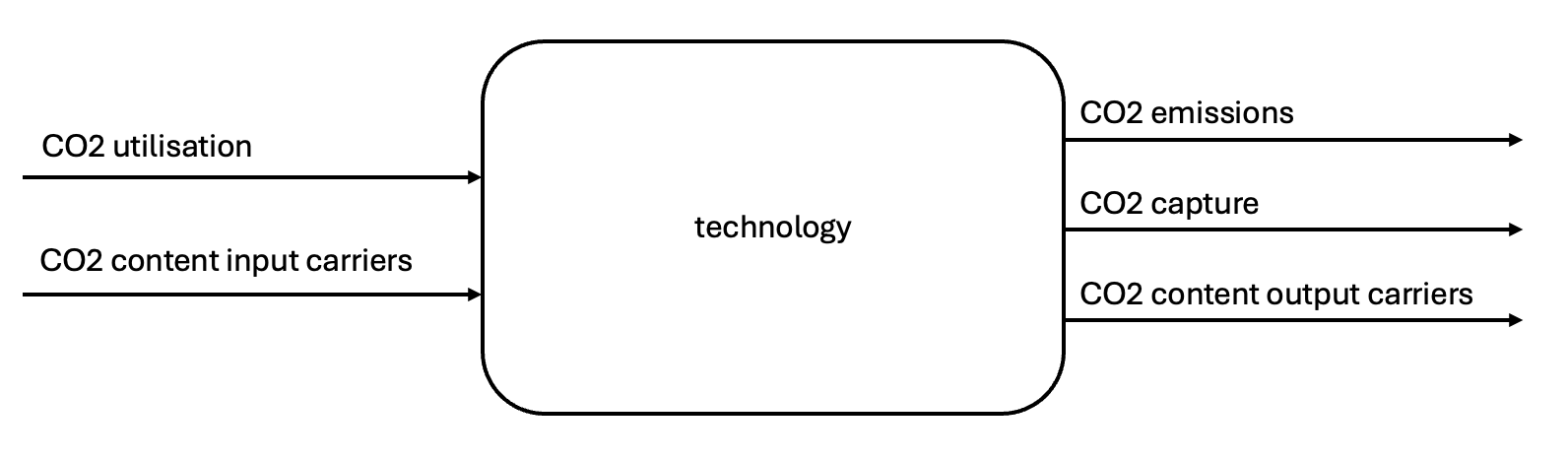
The coal-fired power plant consumes 100 MJ coal. Taking the emission factor of 0.0945 kg CO2/MJ for coal, the resulting CO2 emissions at the power plant are 100 MJ * 0.0945 kg CO2/MJ = 9.45 kg CO2, which are allocated to the energy sector.
Deviation from IPCC guidelines
Due to the modelling structure of the ETM, the allocation of captured and used CO2 emissions in the ETM deviates from the IPCC guidelines.
The ETM deducts captured CO2 emissions from the sector where these emissions are captured. If this CO2 is then used and released in the short term (for example used for the production of synthetic fuels and combusted in an aircraft), the ETM allocates these emissions to the sector where the CO2 is emitted.
From IPCC, 2019 Refinement:
Where CO2 emissions are captured from industrial processes or large combustion sources, captured emissions should be allocated to the sector generating the CO2 unless it can be shown that the CO2 is stored in properly monitored geological storage sites [...]
This means that according to IPCC guidelines, the released CO2 emissions from combustion of the synthetic fuel should be allocated to the sector where the CO2 was originally captured. See the calculation example below for the differences in allocation.
A coal-fired power plant in the energy sector produces 100 kg CO2, of which 80 kg CO2 is captured and 20 kg CO2 is emitted. The captured CO2 is used for synthetic kerosene production, which is later combusted in an aircraft, leading to 80 kg of emitted CO2.
Allocation ETM: the energy sector emits 20 kg CO2, the transport sector emits 80 kg CO2.
Allocation IPCC: the energy sector emits 100 kg CO2, the transport sector emits 0 kg CO2.
Method implementation
Currently, the direct emissions method is implemented as an additional method alongside the default primary emissions method. The results of the direct emissions method can be viewed via a detailed data export. This data export provides a complete overview of all emissions in a scenario for the start year and future year. All technologies where emissions can occur are included and categorised by ETM sector and subsector. In addition, other greenhouse gas emissions that are not dynamically calculated are also included.
The following emission results, expressed in kg CO2-eq, are included in the data export:
- CO2 production: fossil CO2 generated, before CO2 capture.
- CO2 capture: fossil and biogenic CO2 captured.
- Other GHG emissions: total non-CO2 emissions.
- Total GHG emissions: net total GHG emissions, calculated as
CO2 production - CO2 capture + Other GHG emissions.
Go to this page for more technical details on how these emissions are calculated in the model.